


Thursday Afternoons
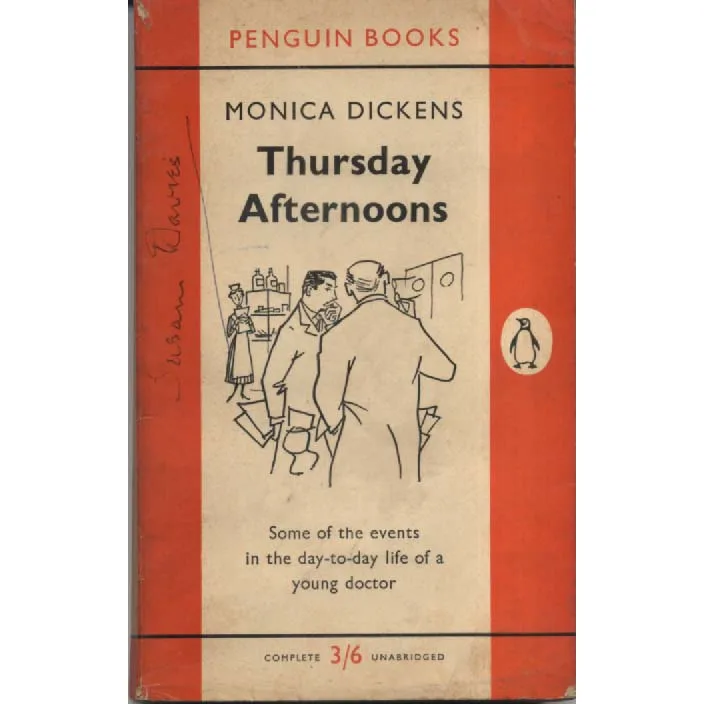
Publisher: Penguin Books
Format: Paperback
ISBN: none
There are novels with dramatic titles involving betrayal, war and doomed passion, and then there is Thursday Afternoons by Monica Dickens — a title so magnificently ordinary it sounds less like a novel and more like a recurring emotional condition experienced somewhere between lunch and mild disappointment. Published in Penguin paperback form in 1958, this is classic Monica Dickens territory: sharply observed British life filled with humour, humanity and the quiet chaos lurking beneath respectable routines.
Because nobody wrote everyday British existence quite like Monica Dickens.
Where other writers searched for extraordinary people, Dickens understood that ordinary people are already more than complicated enough. Somewhere in Thursday Afternoons there will almost certainly be social awkwardness, emotional entanglement, well-meaning confusion and at least one character trying heroically to maintain dignity while events conspire against them. British fiction of this era excelled at precisely that sort of drama: not explosions or conspiracies, but the infinitely more dangerous territory of tea tables, expectations and feelings politely left unspoken for decades.
And honestly, “Thursday afternoons” really are a perfect setting for low-level existential uncertainty. Mondays still possess structure. Fridays contain hope. But Thursday afternoon has a uniquely British emotional texture — the point in the week where people begin staring vaguely out of windows wondering whether this can really be all there is. Monica Dickens clearly recognised the literary potential immediately.
Published in 1958, this Penguin edition comes from that golden age of intelligent paperbacks when serious fiction was sold affordably to commuters, students and quietly overburdened adults travelling home on soot-covered trains. Old Penguins have an atmosphere modern books struggle to replicate. They feel woven directly into everyday life rather than manufactured as lifestyle accessories.
There is also something wonderfully comforting about Monica Dickens’ worldview. She sees human absurdity clearly, but without cruelty. Her characters may be foolish, trapped, stubborn or emotionally chaotic, yet she generally treats them with warmth rather than contempt. In an era where much modern fiction seems determined to prove humanity unbearable, that gentleness feels surprisingly refreshing.
Condition is good overall, with the notable addition of a scribble on the cover — which somehow only increases the charm. Scribbles on old Penguins always invite speculation. Was it a bored student? A distracted commuter? Somebody absentmindedly testing a pen during a rain-soaked train journey in 1963? These marks become part of the book’s archaeological record: tiny traces of previous lives intersecting briefly with the object now sitting in your hands.
And really, old paperbacks should look slightly lived-in. These were not luxury collectibles originally. They were practical companions carried in handbags, coat pockets and suitcases, read in waiting rooms and beside cups of tea while Britain quietly adjusted itself to the post-war world. A perfectly pristine Penguin sometimes feels faintly suspicious, as though it has somehow escaped life entirely.
A delightful copy for admirers of Monica Dickens, collectors of vintage Penguins, lovers of mid-century British fiction, or anyone who appreciates novels where the emotional stakes emerge not from melodrama but from the beautifully complicated business of ordinary human existence. Also ideal for readers who enjoy wit tempered with melancholy and the faint sense that civilisation itself may depend upon keeping calm in awkward social situations.
Crappy Old Books: rescuing slightly scribbled fragments of Britain’s emotional history one Penguin at a time.
Keep browsing: See more Fiction books Other books by Monica Dickens
